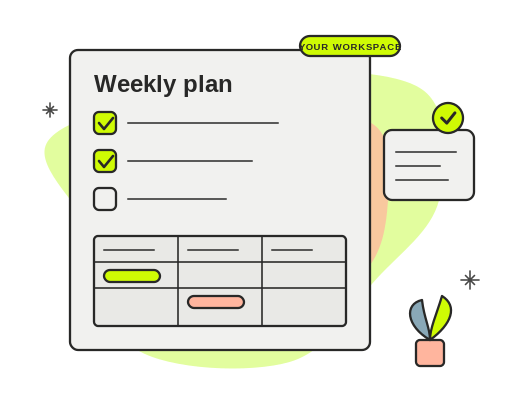
A useful AI routine is not a big system. It is five small tasks across a week, each with a clear input, a prompt, and a check before you rely on the result, finishing on Friday with a short library of prompts worth reusing. The week below is a sample you can adapt. The time saved is something to judge yourself, because it depends on your tool, your work and how carefully you check.
Good to know
Use only tools your organisation has approved, and keep confidential, customer and personal data out of anything that is not. When in doubt, replace names with placeholders.
Monday: summarise the inbox backlog
Task: work out what needs a reply this week. Input: a handful of non-sensitive email threads you copy in, or a summary feature in an approved mail tool. Prompt: "Summarise each thread in one line, say what is being asked of me, and flag anything with a deadline. Do not invent dates." Check: open any thread flagged urgent and read it yourself before acting. Possible benefit: less time re-reading long threads, though you still read the important ones.
Tuesday: turn meeting notes into actions
Task: capture decisions and owners. Input: your own typed notes or an approved transcript. Prompt: "From these notes list decisions, actions (owner and due date if stated) and open questions. If an owner or date is missing, write 'not stated'." Check: compare the actions to what you remember, and confirm unclear owners with the people involved before sending. Possible benefit: a consistent summary written faster, with you still checking it.
Wednesday: tidy a spreadsheet, with a tested formula
Task: clean a column of inconsistent entries. Input: a few sample rows, copied with sensitive data removed, and a description of the columns. Prompt: "Here are five sample rows from columns A to C. Suggest a formula for D that extracts the surname from A. Explain what it does and name the spreadsheet app's function you used." Check: test the formula on rows you can verify by eye, including awkward ones (double-barrelled names, blank cells), then on a copy of the real file before the original. Function names and behaviour differ between spreadsheet programs, so confirm it works in yours.
Thursday: draft a slide outline
Task: get past the blank page for a short presentation. Input: your audience, the one point you want them to remember and your real facts or figures. Prompt: "Draft a six-slide outline for [audience]. Each slide: a headline sentence and three short bullets. Use only the facts I list. Mark with [CHECK] anything that needs a source." Check: replace every [CHECK] with a verified source or delete it, and cut slides that do not serve your one point. Possible benefit: a structure to react to, while you provide the substance.
Friday: review the week and save what worked
Task: build a small personal prompt library. Input: the prompts you used this week. Action: for each one, decide whether it gave a draft you could use with a light edit. Keep those, improve them and file them. Throw away the rest. Check: strip out any names, figures or confidential details so each saved prompt is a reusable template.
A library entry might look like this:
- Name: Meeting notes to actions.
- When to use: after any internal meeting.
- Prompt: "From these notes list decisions, actions with owner and due date, and open questions. Write 'not stated' where information is missing. Do not add anything not in the notes."
- Check: confirm owners and dates with the people involved.
- Last improved: the date and what changed.
Why the week is ordered this way
Monday starts with reading, which is the lowest risk use because you are only asking for a summary of something you already have. Tuesday adds structure. Wednesday introduces a result you can test objectively, which teaches the habit of verifying before trusting. Thursday asks for creative drafting, where your judgement matters most, and Friday turns the week into something reusable. If a day goes badly, the lesson is still worth recording in the library as a note about what not to do.
How to keep the routine honest
- Start each task by choosing the input yourself, rather than pasting whatever is closest.
- Ask the assistant to say when information is missing instead of guessing.
- Read the result before it leaves your hands.
- Note when a task took longer to check than to do, and drop it from the routine.
- Review the library every month and delete prompts you have not used.
Keep a short note of each day's result: what you asked, what you changed and whether it was worth it. After a few weeks you will have your own evidence about where AI helps in your job, which is more reliable than anyone's general claims about productivity.
Assistants can produce fluent errors: a wrong owner, an invented date, a formula that works on easy rows and fails on hard ones. None of the steps above removes that risk. They are designed so you meet the errors while it is cheap to fix them.
Adapting the week to your job
If you rarely write slides, replace Thursday with the task you dread most, such as a status update or a customer reply. If your inbox holds sensitive material, use Monday only with an approved tool or skip it. The pattern stays the same: a small real input, a specific prompt, a check you actually do, and a note of what worked.
The everyday AI skills courses build these habits one task at a time.
Common questions
Do I need to use AI every day for this to work?
No. Treat the week as a menu. Pick the tasks that match your real work, and skip the rest.
How do I know the AI saved me time?
Notice honestly whether the draft needed less work than starting from scratch. If checking took as long as doing the task, that task is not a good fit.
Where should I keep my saved prompts?
Anywhere you will actually find them, such as a document or notes app you already use. Keep them free of customer names and confidential details.
Official pages to check
AI tools change quickly. Check the vendor's current help page before you act, and review anything an AI tool produces before you rely on it.